opening nights are always charged with a little bit of frenetic energy. the artists are nervous, exhausted and excited in equal measure. the supporting family and friends are full of admiration and pride. people mingle, meet and talk while glasses clink and cameras flash.
on a particularly lovely saturday afternoon in november a bustling crowd came in to check out the art of Eliza-Jane Gilchrist, Jason Hartcup and Darcey Bella Arnold. get an inside peak into the scenes with our little launch video below (and come along to the next one - it is going to be MASSIVE):

Showing posts with label contemporary art. Show all posts
Showing posts with label contemporary art. Show all posts
Sunday, November 11, 2012

Saturday, November 10, 2012


Thursday, October 18, 2012
Stefan, viewed again
i just realised that if you take the word 'review' quite literally, it means to look again. it makes me realise that when i read a review i am indeed looking again, in a way, at whatever is being discussed. only, it's looking through the eyes of another as if the reviewer is repeating their experience, for me. and it becomes a second 'viewing' of the work - a reconstruction for the benefit of those not there.
the wonderful Mila Faranov came in to the galleries recently and has written some of her thoughts in response to the work of Stefan Gevers. you can find them on this great blog called Stamm - click on Stefan's image here and be transported by the magic of digital code directly to the review:
the wonderful Mila Faranov came in to the galleries recently and has written some of her thoughts in response to the work of Stefan Gevers. you can find them on this great blog called Stamm - click on Stefan's image here and be transported by the magic of digital code directly to the review:
Stefan Gevers, Rite of spring (2012)
Thursday, October 4, 2012
vibration of place
there's a case among philosopher types in recent times that art is more about the impact that it has on your central nervous system than the simplistic aesthetics of what stimulates your eyes. the idea is that good art moves your organs. it makes you feel something in your inner core.
i mention this because standing in the middle of gallery 1, surrounded by the paintings of kim barter, the room practically vibrates. you feel somehow more alive to the moment because a mild sense of vertigo takes you. your eyes skirt around, looking for a place to settle. your body is jittery, wondering where to stand to take it in. it's activating and invigorating. it's exciting. it's like the shimmer of a hot summer's horizon, lifted up from the edges and pressed up around you in dazzling arrays of colour, shape and movement.

kim has travelled extensively, across the vast variety of geographical environments that make up the australian continent. rather than travel through the landscape, kim takes the time to occupy the space. to soak it in and filter it through the action of her expressive outlet. this is felt landscape, not just seen landscape.
there's a joyous quality to the mark making and brush-strokes. an exhilaration that activates the work. there's the sort of archived expressive action you see in pollock, fed through a contemplative appreciation of place you see in contemporary indigenous australian painting. and i'd be remiss if i didn't mention the colours. oh the colours! vivid, vibrant, vibrational overlay of energies. reds, pinks and sky blues pushing and pulling the warm and cool tones, bringing life to what is two-dimensional.
the show finishes this weekend so get in quick to take it all in. the scale of kim's undertaking in this project is immense and it so congruently fits the large expanse in gallery 1. there's few better ways to activate a space than by occupying it with art of this intensity. so come in quick and join the growing interest in kim's fabulous work.
i mention this because standing in the middle of gallery 1, surrounded by the paintings of kim barter, the room practically vibrates. you feel somehow more alive to the moment because a mild sense of vertigo takes you. your eyes skirt around, looking for a place to settle. your body is jittery, wondering where to stand to take it in. it's activating and invigorating. it's exciting. it's like the shimmer of a hot summer's horizon, lifted up from the edges and pressed up around you in dazzling arrays of colour, shape and movement.

Kim Barter, Coorong
kim has travelled extensively, across the vast variety of geographical environments that make up the australian continent. rather than travel through the landscape, kim takes the time to occupy the space. to soak it in and filter it through the action of her expressive outlet. this is felt landscape, not just seen landscape.
there's a joyous quality to the mark making and brush-strokes. an exhilaration that activates the work. there's the sort of archived expressive action you see in pollock, fed through a contemplative appreciation of place you see in contemporary indigenous australian painting. and i'd be remiss if i didn't mention the colours. oh the colours! vivid, vibrant, vibrational overlay of energies. reds, pinks and sky blues pushing and pulling the warm and cool tones, bringing life to what is two-dimensional.
the show finishes this weekend so get in quick to take it all in. the scale of kim's undertaking in this project is immense and it so congruently fits the large expanse in gallery 1. there's few better ways to activate a space than by occupying it with art of this intensity. so come in quick and join the growing interest in kim's fabulous work.
Saturday, July 21, 2012
taylor made mark making
Ross Taylor had an amazing drawing in a group at c3 Gallery in abbotsford that i saw and loved. it was delicate, full of open space and intricate, detailed penmanship. some time later, through a series of odd coincidences, he landed in kyneton (his girlfriend at the time came to buy a Lucy James artwork) and after i showed him a photo i took of his work that i had kept in my phone (filed under 'shit-hot artists i need to contact') he agreed to put on an exhibition with us.
i love a good set of coincidental connections.
the project space is now lined with a series of fantastic drawings for his solo exhibition - Phatland.

on the rock-like walls of the space, meticulously drawn landscapes float amid a silent white void. there's a few signs of life, appearing sporadically throughout the vast open planes. mostly, it's these wonderful little rock formations, the impact of erosion and time sculpting them into totemic formations - like ziggurats.
look a little closer and you can see the laborious effort of mark-making. miniscule little lines build up to create the elements in the landscape. there's hours of detailed, focused concentration poured into every large sheet of paper. and yet, although made from the tiniest of thin little lines and dots, vast and sweeping expanses are created and we hover, as if from a bird’s eye view above the world.
this could all be seen as a reflection of natural processes, where infinitesimal increments in growth and decay accrue over years, centuries and millennia. where micro processes produce macro results. in an eternal dance, biological forms create landscapes and landscapes create biological forms. It's a reminder that all life started long ago as rocks. rocks break down and dissolve, becoming sand and soil and the building blocks of biology. and then life itself liquifies, petrifies and turns back to sand, soil and rock.
Ross's work throws up all this ideas in the simple act of making marks on sheets of paper. it's quite compelling. he has a way with the composition of his pieces too, where the spaces he leaves become just as important in the work as the very carefully placed ink marks. so much effort put into the drawing and so much power emanating from the blank parts untouched.
i've heard people refer to them as post-apocalyptic. as if most life has been swept away by catastrophe and the barest elements remain. alternatively, they look like planetary maps or moonscapes. either way, they read like the potential for life. you can't help but look around for signs of it. you can't help but read into them a sense of hope. is that little rocky outcrop actually a little tower? what's being built here? who populates this place and where the hell are they?
on that last point you can't help but be reminded that it's you that populates these landscapes. it's your ideas pouring into the vastness, it's your wandering thoughts making stories about why it looks the way it looks. what a lovely gift from Ross, to provide this playground of ideas for our minds.
thanks Ross!
- - - - - - -
come see these works in the flesh, where they do their best work. exhibition runs until 5 August.
i love a good set of coincidental connections.
the project space is now lined with a series of fantastic drawings for his solo exhibition - Phatland.
Ross Taylor, Phatland (detail)
on the rock-like walls of the space, meticulously drawn landscapes float amid a silent white void. there's a few signs of life, appearing sporadically throughout the vast open planes. mostly, it's these wonderful little rock formations, the impact of erosion and time sculpting them into totemic formations - like ziggurats.
look a little closer and you can see the laborious effort of mark-making. miniscule little lines build up to create the elements in the landscape. there's hours of detailed, focused concentration poured into every large sheet of paper. and yet, although made from the tiniest of thin little lines and dots, vast and sweeping expanses are created and we hover, as if from a bird’s eye view above the world.
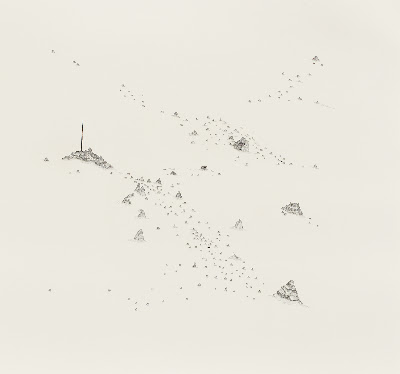
Ross Taylor, Phatland (detail)
this could all be seen as a reflection of natural processes, where infinitesimal increments in growth and decay accrue over years, centuries and millennia. where micro processes produce macro results. in an eternal dance, biological forms create landscapes and landscapes create biological forms. It's a reminder that all life started long ago as rocks. rocks break down and dissolve, becoming sand and soil and the building blocks of biology. and then life itself liquifies, petrifies and turns back to sand, soil and rock.
Ross's work throws up all this ideas in the simple act of making marks on sheets of paper. it's quite compelling. he has a way with the composition of his pieces too, where the spaces he leaves become just as important in the work as the very carefully placed ink marks. so much effort put into the drawing and so much power emanating from the blank parts untouched.
i've heard people refer to them as post-apocalyptic. as if most life has been swept away by catastrophe and the barest elements remain. alternatively, they look like planetary maps or moonscapes. either way, they read like the potential for life. you can't help but look around for signs of it. you can't help but read into them a sense of hope. is that little rocky outcrop actually a little tower? what's being built here? who populates this place and where the hell are they?
on that last point you can't help but be reminded that it's you that populates these landscapes. it's your ideas pouring into the vastness, it's your wandering thoughts making stories about why it looks the way it looks. what a lovely gift from Ross, to provide this playground of ideas for our minds.
thanks Ross!
- - - - - - -
come see these works in the flesh, where they do their best work. exhibition runs until 5 August.
Tuesday, July 17, 2012
the materiality of emptiness
if i mention Einstein will you stop reading this? will it put you off? well, frankly, it's too late for that because there he is, sitting fourth in line of the first sentence. and what's more, here he comes again.
Einstein had this theory that 'empty space' can possess its own energy. those great big expanses of 'nothingness' filling up the gaps between the stars, or the gaps between and inside atoms - maybe they're not empty spaces at all.
for all we know about the universe, the things we observe on earth and in space, we think that we probably have a very rough awareness (not even an understanding) of about 5% of it. by our best, most contemporary estimates, we think that maybe there's about 70% of the universe made up of this mysterious force we call, for want of a better term, 'dark energy', and 25% of a mysterious material we call 'dark matter'.
for me, there's a parallel here with art. we make art to explore and express the great mysteries of the unknown. artists are out there, in the big open expanses of 'the universal void', scrambling about in the dark, piecing things together out of materials and non-materials to try and shed some light on our reality.

dark matter_dark energy is a constellation of artists who reflect this way of thinking about art practice. each, in their own unique way, with their own unique approaches, grapple with the unknowable void and the forces and materials that make it up. and the reason for bringing their work together into a curated group show format is to play further on that idea of 'empty space possessing energy'. because in a group show situation, sitting between each work in the gallery, is a vast openness of space. the actual paintings, sculptures and screens take up about 5% of the gallery. it's the in-between space where the audience walks around, where the lights cast their illuminating glow and the ideas about the works bounce off each other, combine, repel and play, that constitutes the 95% of 'empty' space made up of something not unlike dark matter, dark energy.
in quantum theory (now if Einstein didn't put you off, i hope quantum physics won't either) there's a thought that maybe dark energy is actually a big mess of particles that continually form and then disappear. imagine that, trillions upon trillions of particles popping into existence, only to instantly disappear again. constantly. like ideas.
another thought is that maybe it's a type of liquid that we haven't figured out how to measure. or maybe a field, like magnetism.
dark matter, on the other hand, seems more likely to be some sort of actual material, just not detectable to our instruments. one of the theories is that it's particles called ... i love this ... 'weakly interacting massive particles' (WIMPs).
anyway - let's get back to art here. this isn't a science blog for crying out loud.
(in space, no one can hear you scream).
here's my take on the works of each individual artist, and why i see a relationship to the ideas above. each artist has their own ideas, of course, and their own expectations about what they're doing. like distant galaxies working their own orbital fields of planetary combinations. i'm just one observation point, trying to decipher the patterns in the void.
Michael Needham

what volume of space is death? what empty hole is left by a life dissolved? Michael has taken a casting of the depression left in the ground when a grave site sinks into the earth. his sculpture is an absence made present. this is a void made material. he's presented it like a relic, a museum piece, as if it's a casting from the print of a dinosaur or the inside of a sarcophagus. it's a monument, and it's monumental. and yet, the grave from which it was taken, is unmarked. an unknown death. an unremarked absence.
Michael's use of dental plaster reinforces thoughts of the human body. while the sculpture is a material translation of a hole in the ground, a sort of landscape art, it's also a sort of portrait. and in death, it's not uncommon to turn to dental evidence when in need of attributing an identity.
the plaster itself, with its bubbling, rippling and also eroded feel to it, evokes the landscape. not unlike sandstone or limestone it's like rock formations you see at beaches and along coastlines. and this tension between landscape and portraiture spins off ideas about belonging to the land, of being part of the land - dust to dust, we are all made of stars.
Nicholas Ives

the darkly psychological portraits that Nicholas produces speak of the inner depths of the human mind. in the same way that some philosophers claim our grappling for knowledge about the universe is simply a grappling of knowledge about ourselves, these portraits reflect the unfathomable recesses of the psyche. the subjects in the paintings emerge from shadowy backgrounds, their outlines obscured by the darkly rich layering of oils. their facial features blend into their surroundings, and their surroundings become palpable. the shadows, the backgrounds, they become material. heavy, soupy atmospheres.
staring into portraits is always in some sense staring into reflections of ourselves. we're hardwired to look for signals in the human face, for recognisable familial traits and for symbols of communication. having sat with the portraits for a little while now, i've been noticing their changing characters. from different angles they seem either sad, haunting, frightening or melancholy. the way in which they're painted means they're almost alive as you move about the gallery space. and with three together on the wall there's a whole assortment of relationships or communications between the group that you can't help but wonder about. what are they whispering to each other when i'm not in the room?
Sally Blenheim

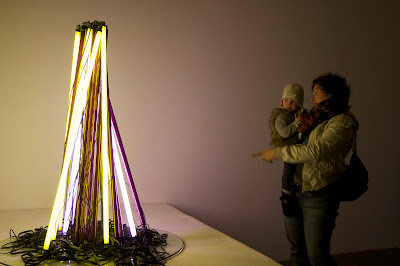
Sally uses light as if it’s a material entity. and then there’s gravity. oh, we mustn’t forget there’s also electrical energy. the precariously teetering form is an exercise in balancing force.
there’s a precarious and tense balance between tangible and intangible materials - a cone of fluorescent tubes and the weight of light that cone produces around itself, electrical cabling that supplies both physical support and pulses of energy, gravity that pulls it all together while all the while trying to pull the whole thing down.
light changes the atmosphere of the space, blurring the hard boundary of the gallery walls and emitting a glow that dyes the air with energy. and you’ll have to enter the rest of the show through this luminous fog and be bathed by it on the way out.
Tristan Jalleh

the cyclical nature of universal forces, of destruction and creation, are poetically expressed in the throbbing plumes of smoke of Verge 2. floating in an expanse of endless white, looping infinitely like a breathing galaxy, the beauty of this video work is in its simplicity. a simplicity of complex relations.
a stadium is destroyed. a circular platform for viewing. In the centre of any given stadium is where the action traditionally takes place. the field of play. some 20-odd human bodies, jostling about, like a molecule of different atoms. Following rules, behaving collectively, behaving competitively. and yet around that open field, sits thousands of spectators. observers whose very act of observing influences the outcome of play. oh look, it's our old friend, quantum mechanics again.
and here we are, watching it all on a screen. spectators observing the destruction of a spectator structure. on a spectator structure. A destruction now rendered as a creation.
Jacques Soddell

nothing quite fills an empty void like sound. rippling waves of air pulsating across the room, tickling the hairs inside your ears. when you think about it, sound doesn't exist in the air. only little waves in the air exist. that noise we hear - that's only inside our brains. that's our brain translating vibration into tone. the 'sound' is only inside our heads.
Jacques knows how to manipulate vibration, how to make sound a spatial material. stand in different parts of the gallery and you'll get a different physical feeling caused by his sounds. he is technically minded and the thoughts behind his work are compelling:
In 1916 Einstein suggested that there is no such a thing as empty space. Similarly John Cage’s 4’33” (1951) was about lack of silence. Even black holes emit a sound - the sound of B flat, 57 octaves lower than middle-C, is rumbling away from a supermassive black hole in the Perseus cluster. So this piece is also about lack of emptiness. When discussing the “empty” universe (Dark Matter & Dark Energy), astro scientists talk about MACHOs (massive compact halo objects) and WIMPs (weakly interacting massive particles), but I have uncovered LAMBS (lucid aggregates of mobile baryonic sounds), and these form the basis of my piece. Granular synthesis of white noise is the main source producing both particulate and continuous sounds, but is interrupted by the throbbing of B flat, the note detected in black holes (although here it is 54 octaves higher (29.135Hz) to make it audible, and is modulated by a couple of other sine waves). A Higgs-like glissando makes a brief appearance on the Bose-on sound system.
WARNING: low frequencies occur.
Adam John Cullen

Adam’s cluster of sculptures on the floor reads like a constellation of phrases arranged in a chemical molecule. if you move any one of the component parts the force that binds them as a unit is disrupted and realigns with a new feeling that fine-tunes an effect in your stomach.
balance is temporally important, temporarily. always undercut by a force that appears as both an archive of its
action and the tension of its reappearance. the cluster sits as a mini-reflection of the whole show. centred in the space, an arrangement carefully placed, it is a pattern of a pattern. an echo of the placement of 6 artists' work in the gallery. a fractal of a pattern of a resonance.
the hand of the individual artist is also ever present. these are objects that have been conspicuously acted on. the hovering ghost of the hands laid upon these forms is in the room. and the probability of more clumsy hands about to get at them lurks in the shadows.
- - - - - - - - - - - -
the exhibition runs until 5 August.
(Michael Needham appears courtesy of Daine Singer Gallery)
Einstein had this theory that 'empty space' can possess its own energy. those great big expanses of 'nothingness' filling up the gaps between the stars, or the gaps between and inside atoms - maybe they're not empty spaces at all.
for all we know about the universe, the things we observe on earth and in space, we think that we probably have a very rough awareness (not even an understanding) of about 5% of it. by our best, most contemporary estimates, we think that maybe there's about 70% of the universe made up of this mysterious force we call, for want of a better term, 'dark energy', and 25% of a mysterious material we call 'dark matter'.
for me, there's a parallel here with art. we make art to explore and express the great mysteries of the unknown. artists are out there, in the big open expanses of 'the universal void', scrambling about in the dark, piecing things together out of materials and non-materials to try and shed some light on our reality.

Hubble telescope's 3D model map of dark matter
dark matter_dark energy is a constellation of artists who reflect this way of thinking about art practice. each, in their own unique way, with their own unique approaches, grapple with the unknowable void and the forces and materials that make it up. and the reason for bringing their work together into a curated group show format is to play further on that idea of 'empty space possessing energy'. because in a group show situation, sitting between each work in the gallery, is a vast openness of space. the actual paintings, sculptures and screens take up about 5% of the gallery. it's the in-between space where the audience walks around, where the lights cast their illuminating glow and the ideas about the works bounce off each other, combine, repel and play, that constitutes the 95% of 'empty' space made up of something not unlike dark matter, dark energy.
in quantum theory (now if Einstein didn't put you off, i hope quantum physics won't either) there's a thought that maybe dark energy is actually a big mess of particles that continually form and then disappear. imagine that, trillions upon trillions of particles popping into existence, only to instantly disappear again. constantly. like ideas.
another thought is that maybe it's a type of liquid that we haven't figured out how to measure. or maybe a field, like magnetism.
dark matter, on the other hand, seems more likely to be some sort of actual material, just not detectable to our instruments. one of the theories is that it's particles called ... i love this ... 'weakly interacting massive particles' (WIMPs).
anyway - let's get back to art here. this isn't a science blog for crying out loud.
(in space, no one can hear you scream).
here's my take on the works of each individual artist, and why i see a relationship to the ideas above. each artist has their own ideas, of course, and their own expectations about what they're doing. like distant galaxies working their own orbital fields of planetary combinations. i'm just one observation point, trying to decipher the patterns in the void.
Michael Needham

Michael Needham, intra limen
what volume of space is death? what empty hole is left by a life dissolved? Michael has taken a casting of the depression left in the ground when a grave site sinks into the earth. his sculpture is an absence made present. this is a void made material. he's presented it like a relic, a museum piece, as if it's a casting from the print of a dinosaur or the inside of a sarcophagus. it's a monument, and it's monumental. and yet, the grave from which it was taken, is unmarked. an unknown death. an unremarked absence.
Michael's use of dental plaster reinforces thoughts of the human body. while the sculpture is a material translation of a hole in the ground, a sort of landscape art, it's also a sort of portrait. and in death, it's not uncommon to turn to dental evidence when in need of attributing an identity.
the plaster itself, with its bubbling, rippling and also eroded feel to it, evokes the landscape. not unlike sandstone or limestone it's like rock formations you see at beaches and along coastlines. and this tension between landscape and portraiture spins off ideas about belonging to the land, of being part of the land - dust to dust, we are all made of stars.
Nicholas Ives
Nicholas Ives, The Slow Story of the Felling
the darkly psychological portraits that Nicholas produces speak of the inner depths of the human mind. in the same way that some philosophers claim our grappling for knowledge about the universe is simply a grappling of knowledge about ourselves, these portraits reflect the unfathomable recesses of the psyche. the subjects in the paintings emerge from shadowy backgrounds, their outlines obscured by the darkly rich layering of oils. their facial features blend into their surroundings, and their surroundings become palpable. the shadows, the backgrounds, they become material. heavy, soupy atmospheres.
staring into portraits is always in some sense staring into reflections of ourselves. we're hardwired to look for signals in the human face, for recognisable familial traits and for symbols of communication. having sat with the portraits for a little while now, i've been noticing their changing characters. from different angles they seem either sad, haunting, frightening or melancholy. the way in which they're painted means they're almost alive as you move about the gallery space. and with three together on the wall there's a whole assortment of relationships or communications between the group that you can't help but wonder about. what are they whispering to each other when i'm not in the room?
Sally Blenheim

Sally Blenheim, Fire
Sally uses light as if it’s a material entity. and then there’s gravity. oh, we mustn’t forget there’s also electrical energy. the precariously teetering form is an exercise in balancing force.
there’s a precarious and tense balance between tangible and intangible materials - a cone of fluorescent tubes and the weight of light that cone produces around itself, electrical cabling that supplies both physical support and pulses of energy, gravity that pulls it all together while all the while trying to pull the whole thing down.
light changes the atmosphere of the space, blurring the hard boundary of the gallery walls and emitting a glow that dyes the air with energy. and you’ll have to enter the rest of the show through this luminous fog and be bathed by it on the way out.
Tristan Jalleh

Tristan Jalleh, Verge 2 (video still)
the cyclical nature of universal forces, of destruction and creation, are poetically expressed in the throbbing plumes of smoke of Verge 2. floating in an expanse of endless white, looping infinitely like a breathing galaxy, the beauty of this video work is in its simplicity. a simplicity of complex relations.
a stadium is destroyed. a circular platform for viewing. In the centre of any given stadium is where the action traditionally takes place. the field of play. some 20-odd human bodies, jostling about, like a molecule of different atoms. Following rules, behaving collectively, behaving competitively. and yet around that open field, sits thousands of spectators. observers whose very act of observing influences the outcome of play. oh look, it's our old friend, quantum mechanics again.
and here we are, watching it all on a screen. spectators observing the destruction of a spectator structure. on a spectator structure. A destruction now rendered as a creation.
Jacques Soddell

The visible patterns of sound waves, Bell Laboratories
nothing quite fills an empty void like sound. rippling waves of air pulsating across the room, tickling the hairs inside your ears. when you think about it, sound doesn't exist in the air. only little waves in the air exist. that noise we hear - that's only inside our brains. that's our brain translating vibration into tone. the 'sound' is only inside our heads.
Jacques knows how to manipulate vibration, how to make sound a spatial material. stand in different parts of the gallery and you'll get a different physical feeling caused by his sounds. he is technically minded and the thoughts behind his work are compelling:
In 1916 Einstein suggested that there is no such a thing as empty space. Similarly John Cage’s 4’33” (1951) was about lack of silence. Even black holes emit a sound - the sound of B flat, 57 octaves lower than middle-C, is rumbling away from a supermassive black hole in the Perseus cluster. So this piece is also about lack of emptiness. When discussing the “empty” universe (Dark Matter & Dark Energy), astro scientists talk about MACHOs (massive compact halo objects) and WIMPs (weakly interacting massive particles), but I have uncovered LAMBS (lucid aggregates of mobile baryonic sounds), and these form the basis of my piece. Granular synthesis of white noise is the main source producing both particulate and continuous sounds, but is interrupted by the throbbing of B flat, the note detected in black holes (although here it is 54 octaves higher (29.135Hz) to make it audible, and is modulated by a couple of other sine waves). A Higgs-like glissando makes a brief appearance on the Bose-on sound system.
WARNING: low frequencies occur.
Adam John Cullen

Adam John Cullen's cluster of sculptures (foreground)
Adam’s cluster of sculptures on the floor reads like a constellation of phrases arranged in a chemical molecule. if you move any one of the component parts the force that binds them as a unit is disrupted and realigns with a new feeling that fine-tunes an effect in your stomach.
balance is temporally important, temporarily. always undercut by a force that appears as both an archive of its
action and the tension of its reappearance. the cluster sits as a mini-reflection of the whole show. centred in the space, an arrangement carefully placed, it is a pattern of a pattern. an echo of the placement of 6 artists' work in the gallery. a fractal of a pattern of a resonance.
the hand of the individual artist is also ever present. these are objects that have been conspicuously acted on. the hovering ghost of the hands laid upon these forms is in the room. and the probability of more clumsy hands about to get at them lurks in the shadows.
- - - - - - - - - - - -
the exhibition runs until 5 August.
(Michael Needham appears courtesy of Daine Singer Gallery)
Saturday, July 14, 2012
art warms the air
in the dead middle of winter, with rain and wind and chill biting at your bones, there's few things as heart warming as dozens and dozens of people turning up to look closely at the creative work of talented people. artists who, more often than not, work at multiple jobs, pour funds into projects that offer limited hope of financial return but plug away obsessively producing beautiful and captivating sculptures, paintings, drawings, photographs and sounds just for us to engage with.
i know i have vested interests in this, but it still always amazes me. sitting in studios, sitting in bedrooms, standing at easels, investing time into creating work. making art is not working for a wage. you can't clock in and claim $25 an hour for your time. and then, to add more tension to the process, putting themselves and the public opinion of their work on the line, for anyone to come and stand in front of and say, 'my kid could do that'. but .... hopefully... you'll get the occasional 'wow, that's amazing' or 'shit, i never thought of that' or watch someone stand in front of your work mesmerised, saying 'what? you made that video of an exploding stadium out of still photos? and the plumes of smoke are pyroclastic gas from volcanoes? holy fuck that's cool'.
so, last night, with freezing central highlands air driving all and sundry for the comfort of their doonas, a happy, warm and excited crowd milled about the spaces of the galleries, talking about the artists and their work, and noone even noticed it was cold anymore. it's so accurate that in our language we use the term 'warmth' to describe relationships between people.
we warmly invite you. that warms my soul. you warm my heart.
anyway - last night was great fun. i managed to get some snaps of the event, in between chatting about the work and catching up with people. and while i'm here, again with confessed vested interest, if you want to put some warmth into your life, put a little warmth into the life of others too, i can show you some seriously amazing creative work, by some amazingly creative people, that would look amazing in your house or workspace. seriously. some of these guys are going to be huge.
end of rant.
start of photos.



i know i have vested interests in this, but it still always amazes me. sitting in studios, sitting in bedrooms, standing at easels, investing time into creating work. making art is not working for a wage. you can't clock in and claim $25 an hour for your time. and then, to add more tension to the process, putting themselves and the public opinion of their work on the line, for anyone to come and stand in front of and say, 'my kid could do that'. but .... hopefully... you'll get the occasional 'wow, that's amazing' or 'shit, i never thought of that' or watch someone stand in front of your work mesmerised, saying 'what? you made that video of an exploding stadium out of still photos? and the plumes of smoke are pyroclastic gas from volcanoes? holy fuck that's cool'.
so, last night, with freezing central highlands air driving all and sundry for the comfort of their doonas, a happy, warm and excited crowd milled about the spaces of the galleries, talking about the artists and their work, and noone even noticed it was cold anymore. it's so accurate that in our language we use the term 'warmth' to describe relationships between people.
we warmly invite you. that warms my soul. you warm my heart.
anyway - last night was great fun. i managed to get some snaps of the event, in between chatting about the work and catching up with people. and while i'm here, again with confessed vested interest, if you want to put some warmth into your life, put a little warmth into the life of others too, i can show you some seriously amazing creative work, by some amazingly creative people, that would look amazing in your house or workspace. seriously. some of these guys are going to be huge.
end of rant.
start of photos.

Ross Taylor

Sally Blenheim

Nicholas Ives


Michael Needham

John Barter


Ross Taylor


Wednesday, June 27, 2012
Meet Your Maker: Alison Eggleton
Alison Eggleton produces sculptural works of a highly tactile nature, working predominantly with textiles and fabrics. For Within Patterns she has produced two wonderful pieces which take as their starting points the designs of carpet and wallpaper. In her hands she has summoned the complex patterns of these designs into three-dimensional forms, evoking landscapes and the dynamic interplay of repetitive symbols in our architectural adornments. I chatted with Alison about her work and the ideas that drive her.

Alison:
It’s interesting that you refer to tectonic plates. I think the carpet work draws your gaze to it, like a gravitational force. The shapes appear to shift, advance and recede, creating a geography that is free of logic, where the viewer could imagine the shapes rising and falling and continuing across the perimeter of the installation. What l remember most of this pattern, is that while each shape is locked in by repetition, one colour - cream - leaps out and is made autonomous. It is often this illusionary quality of patterns that draws my attention or sticks in my memory. Particularly if the effect is sculptural. It’s how l’ve chosen to recall this experiential place of play while concurrently allowing it to hover in the space of the propositional.
Growing up on a poultry farm in a coast town, l was always outside. With my hands in the earth, making things, collecting eggs, or down the beach combing over rock pools. It was only cold and rainy days l would spend inside the house. Maybe this is why l think of carpet as the embodiment of the domestic realm. Carpet and fabrics to me have always been about the luxury of touch, the act embodying a sensual relation to material and form. During the opening, I witnessed people stand and staring into the pattern and others squatting to run their hands over the material surface of the carpet. That to me, makes the work.
Why choose carpet to make carpet? Well the tactile quality and structure of the three kinds of carpet used was perfect for constructing the pattern and form of this work.

Alison:
Nostalgia is not usually something l drawn on. But there is no denying it is the foundation for these works. The tactile and haptic nature of the carpet work is established within a place of play. Although the pattern allows for a sense of visual shift across its landscape, as propositional space is more about whether other people respond to this, rather than wanting to re-live the act of playing matchbox cars. The pattern reminds me of locks, groupings of lines turns inwards, inter locking with the next and running at parallels, the design of which lends itself to a grounded floor work.
I do tend to gravitate to 70’s pattern designs that have illusionary qualities. It is often the simplest designs that are transcendental. Moorish architecture and interior pattern design have a similar effect. The fluidity of the line in the wall pattern are from a dining room wallpaper design that l recall vividly. The pattern sent my childhood mind to wonder, inventing scenarios. The physicality of the lines, the shiny textiles and the explosion of fruit salad colours makes reference to ‘otherness’; far way places across the sea, exotic fruit, exotic people. Hence the floating pineapples and pineapple boat motif.
I don’t think that my experience of growing up in a Anglo Australian family in the 70’s was particularly unique.
Everyone has a history, a sense of belonging to their surroundings, that exists alongside ethnicity and cultural values. Tapping into these commonalities is what interests me.

Alison:
I have found that working in an art related role has exposed me to so many more artists' work than time or inclination allowed previously. I am constantly spirited by what l see produced by other artists, particularly in contemporary Australian photography. Although l have a sculptural-spatial practice, l am discovering that photography is as physically moving as any haptic response to a 3D work can be.
Documenting and writing comes more naturally now too and this has definitely impacted on how l approach a new body of work or collaboration. As a curator, writing about other artists work has given me the confidence to look within my own history for the germ of an idea and take it to full conceptual development (as in ‘Within patterns’) rather than only seeing value in the external.
- - - - - - - -
Big thanks to Alison for letting me dig into her thoughts and for being so eloquent and open with her information for us.
The exhibition runs until July 8 and if you are looking for some pretty amazing art for a big wall in your house or place of business (even Carpet can be mounted) - you know where to come!

Alison Eggleton, Wallpaper
Kent:
Hi Alison, there's a very strong sense of tactility and dynamism in the textile materials you use in your work. The appear like fractured tectonic plates, as if the patterns are alive and moving out into 3-dimensions from flat 2-dimensional beginnings. What drew you to working with this material/medium?
Alison:
It’s interesting that you refer to tectonic plates. I think the carpet work draws your gaze to it, like a gravitational force. The shapes appear to shift, advance and recede, creating a geography that is free of logic, where the viewer could imagine the shapes rising and falling and continuing across the perimeter of the installation. What l remember most of this pattern, is that while each shape is locked in by repetition, one colour - cream - leaps out and is made autonomous. It is often this illusionary quality of patterns that draws my attention or sticks in my memory. Particularly if the effect is sculptural. It’s how l’ve chosen to recall this experiential place of play while concurrently allowing it to hover in the space of the propositional.
Growing up on a poultry farm in a coast town, l was always outside. With my hands in the earth, making things, collecting eggs, or down the beach combing over rock pools. It was only cold and rainy days l would spend inside the house. Maybe this is why l think of carpet as the embodiment of the domestic realm. Carpet and fabrics to me have always been about the luxury of touch, the act embodying a sensual relation to material and form. During the opening, I witnessed people stand and staring into the pattern and others squatting to run their hands over the material surface of the carpet. That to me, makes the work.
Why choose carpet to make carpet? Well the tactile quality and structure of the three kinds of carpet used was perfect for constructing the pattern and form of this work.

Alison Eggleton, Carpet (detail)
Kent:
As you've hinted at, there's an element of nostalgia going on with the work. There's a feeling, especially with the carpet piece, of being young again and being down on the floor playing around with toys, inventing scenarios. And in a different way, with the wall piece, I'm reminded of 70s interior design, restaurant fit outs and crazy curtain patterns. What is it about historical legacy that interests you?
Alison:
Nostalgia is not usually something l drawn on. But there is no denying it is the foundation for these works. The tactile and haptic nature of the carpet work is established within a place of play. Although the pattern allows for a sense of visual shift across its landscape, as propositional space is more about whether other people respond to this, rather than wanting to re-live the act of playing matchbox cars. The pattern reminds me of locks, groupings of lines turns inwards, inter locking with the next and running at parallels, the design of which lends itself to a grounded floor work.
I do tend to gravitate to 70’s pattern designs that have illusionary qualities. It is often the simplest designs that are transcendental. Moorish architecture and interior pattern design have a similar effect. The fluidity of the line in the wall pattern are from a dining room wallpaper design that l recall vividly. The pattern sent my childhood mind to wonder, inventing scenarios. The physicality of the lines, the shiny textiles and the explosion of fruit salad colours makes reference to ‘otherness’; far way places across the sea, exotic fruit, exotic people. Hence the floating pineapples and pineapple boat motif.
I don’t think that my experience of growing up in a Anglo Australian family in the 70’s was particularly unique.
Everyone has a history, a sense of belonging to their surroundings, that exists alongside ethnicity and cultural values. Tapping into these commonalities is what interests me.

Alison Eggleton, 'Within Patterns' installation view
Kent:
You also work as a curator at the Horsham Regional Art Gallery, aside from your own art practice. Is there a cross-pollination of ideas and practice in your work? Alison:
I have found that working in an art related role has exposed me to so many more artists' work than time or inclination allowed previously. I am constantly spirited by what l see produced by other artists, particularly in contemporary Australian photography. Although l have a sculptural-spatial practice, l am discovering that photography is as physically moving as any haptic response to a 3D work can be.
Documenting and writing comes more naturally now too and this has definitely impacted on how l approach a new body of work or collaboration. As a curator, writing about other artists work has given me the confidence to look within my own history for the germ of an idea and take it to full conceptual development (as in ‘Within patterns’) rather than only seeing value in the external.
- - - - - - - -
Big thanks to Alison for letting me dig into her thoughts and for being so eloquent and open with her information for us.
The exhibition runs until July 8 and if you are looking for some pretty amazing art for a big wall in your house or place of business (even Carpet can be mounted) - you know where to come!
Wednesday, June 20, 2012
Meet Your Maker: The Brothers Butterworth
Daniel Butterworth. Matthew Butterworth. The Brothers Butterworth. Two great artists that just happen to be brothers. I've been intrigued about the Butterworth boys for some time as they come with a bit of a reputation. Everyone loves them. When I told people they were exhibiting there was a truly palpable sense of excitement. I get people coming straight up to my desk to ask - 'So, where are the Butterworth paintings?' - even before they walk into the gallery spaces. When I sent out the media releases I got one email straight back from a magazine that said something along the lines of 'Wow, I love these guys - tell me more and we'll let everyone know about it'.
So with a lead-up like that, you know there's something amazing on the way. And true to form and expectation - bang! They delivered.
I've been shooting emails back and forth with both artists individually, probing them on aspects to their practice and ideas, and brought it together in the following interview, for your enjoyment. With the same passion that's poured into their art, they turned out some great insights for us.

Kent:
Hey Matt and Dan! First, I wanted to ask about the way in which you guys exhibit as a pair. The work we have at Stockroom is a big, bold painting show and there's some relationships across the works, but there's also a sense of individuality for each of you. Daniel, you've got a series of still-lifes using crushed cans that envelopes the space and borders on the figurative - as if the cans are standing in for human subjects. And Matthew, you've got an epic landscape painted on panels, propped up at the far end of the space, drawing reference from Australian art-history while being painted in a much more contemporary style and presentation. How do you go about planning, arranging and curating your shows as a pairing of artists?
So with a lead-up like that, you know there's something amazing on the way. And true to form and expectation - bang! They delivered.
I've been shooting emails back and forth with both artists individually, probing them on aspects to their practice and ideas, and brought it together in the following interview, for your enjoyment. With the same passion that's poured into their art, they turned out some great insights for us.

Daniel Butterworth, Pile up
Kent:
Hey Matt and Dan! First, I wanted to ask about the way in which you guys exhibit as a pair. The work we have at Stockroom is a big, bold painting show and there's some relationships across the works, but there's also a sense of individuality for each of you. Daniel, you've got a series of still-lifes using crushed cans that envelopes the space and borders on the figurative - as if the cans are standing in for human subjects. And Matthew, you've got an epic landscape painted on panels, propped up at the far end of the space, drawing reference from Australian art-history while being painted in a much more contemporary style and presentation. How do you go about planning, arranging and curating your shows as a pairing of artists?
Daniel:
Matt and I know each other very well and have always trusted each other in the choices we make. When we first got together with the Stockrooms and it was decided that we would have an exhibition, had you said that the human form would not be seen, I would have laughed at you. Matt phoned me one night and said that he might do some landscapes for the show, and I replied with the idea of wanting to paint some still lifes. From there it grew into what hangs on the walls at the Stockrooms. Matt and I have always complemented each other with our hangs. I believe that it is because we understand each other and when all is said and done we are very similar people.
Matthew: "I have no idea what Dan has written, hopefully the complete opposite to me to really mess your editing process. I've just packed my pipe full of tobacco, poured a drink and rested my glass on a first edition copy of Hardy's 'Tess of the Durbervilles', now question one, let me see (thinking pose.....)."
This is probably the first show whereby Dan and I have not seen each others work prior to the hang. In the past we have either worked together on the one body of work (painting on the same images), or worked separately and kept each other in touch with our own progress. We've never said we would remain committed to anyone of these approaches, we just do what we need to to get an awesome show up- hopefully we have done this time around. I must say, i really enjoyed the mystery around this show-(a throw back to my ScoobyDoo days) I loved not knowing what Dan was up to, I mean I knew he was painting cans but I hadn't seen them (I wondered if he was using this term as a breasts reference, I was wrong), and he hadn't seen my stuff. We would talk on the phone, but hey not like seeing the stuff first hand. I think for our next show I just might copy all of Dan's work, just to mess with buyers and stuff, people love to compare our work (it's only natural) so this would just mess with them.

Matthew Butterworth, Bush Burial (detail)
Kent:
You've both used unusual foundations for you work - brown paper and door panels. Could you tell us why you're drawn to these materials to paint on?
Daniel:
Working on paper has always been a love of mine. When I stumbled on the paper I am currently using it worked for me. When paint was applied it didn't suck the oil out and the application of the paint was smooth and fast.But what I really enjoy about the paper is that I no longer feel precious. When I painted on canvas it could of been up to a week preparing and making it, so before I had put any oil on it at all I had committed so much time to it. Now I enjoy when I am so psyched I can keep painting, just rip off another length and keep going. So it is the instantaneous and availability that it brings to my work that attracts me to it.
Matthew:
I've painted this work on 3 door panels for a few reasons, unfortunately most of them pretty practical ones. I love Jim Morrison, and see him as the messiah, hence the three reference ... ha ha!
Primarily I love the surface, pre-primed board, slick and ready to paint. They are cheap and perfect proportions for this piece. I love the way they just lean against the wall, like a Richard Serra only not rusted metal and extremely masculine and dangerous.
In saying this I never limit my materials to a limited number of choices ie: canvas, paper and board. I let the idea dictate the execution, if I think I should paint with coloured sand, or letters written to my hot school-teacher when I was in year seven, then that's what I will use. It's just that in this case these door panels really suited my needs, and hey, in the end I could renovate my house with them.

Daniel engaging an enthralled audience
Kent:
There's a palpable sense of energy in both of your painting styles. A freshness of brushstrokes, a freedom in the application of the oils and acrylics, a vibrancy. What is it about the act of painting, and the choice to use painting as an artistic medium, that keeps you motivated and keeps you striving to produce new works?Daniel:
Having the paint slide around on the paper, understanding what will happen when I put that colour on top of that. When I nail a painting, paintwork is a big factor. I have always painted wet into wet. Knowing it could all turn to mud in a second is exciting and it also pushes me to work faster. I very rarely get the need or want to explore different media but when I do, I feel that the idea would be better had I used oils on paper.
Matthew:
Why paint? This is a hard one to answer, there's just something unbelievably seductive and inviting about paint. I guess the best way to describe it is that I get lost in it, I love that feeling when I make a mark (a painted mark) that works I feel amazing, makes me sound like a wanker but it's true. When I paint the figure, I love the way you can play with flesh in paint, oil lends itself to the rawness, the colour changes and feel of skin. I love under painting in acrylic, I work fast, bold and more recently I under paint with a shock of colour, then work over the top in oil and see what under painting remains. I'm really interested in my subject matter (a figure, the landscape etc) and I'm interested in how to use paint as a vehicle (I've forgotten where I was going with this, Michael Jackson is on tv and he distracted me - bloody Jackson and all that moon walking) any way - I love paint and expect to do it for as long as I live, even if I went blind, I would still paint - it's is so sculptural you could just manipulate it with your hands.
Hmmm... Maybe I should paint a portrait of MJ? What period though - Off the Wall for sure.
"Ok now to question 4:
I started painting when I was 4 years, 3 months and 2 days. I remember catching a glimpse of a Caravaggio at the Louvre, we were in Paris on a family holiday, on our way back to Italy. We went there every spring to catch the change of colours on the outskirts of Rome. I remember we ate pate and drank sparkling rainwater, my sister commented that it tasted like the sweat of angels ..."
- - - - - -
Ha ha! What a treat it was to interview Matt and Dan. Their work is on the walls of Gallery 1 at Stockroom until 8 July, so if you haven't swung by yet, please come on down and see what all the fuss is about. And support the arts and the artists - buy a piece!!
Thursday, June 14, 2012
wall art, art wall
recent Stockroom Gallery exhibitor Renee Cosgrave (Rhythm and Pulse show, April 2012) has produced this large-scale mural in melbourne city as part of the laneway commissions and next wave festival events:


image courtesy: Stephanie Stott
it'll be up until november at Windsor Place in the CBD. Renee has a lovely piece of art on display at Stockroom too at the moment - a small abstract painting on wood.
Tuesday, June 12, 2012
Meet Your Maker: Grant Nimmo
Wild forests, floating neon orbs, voodoo skulls by candle light and drum sets collapsing into the grass. Is it 'Newage' or is it 'New Age'? I've been captivated and intrigued by Grant Nimmo's work for some time. His gallerist - Anna Pappas - was around the corner from where I lived in Prahran and a rare jewel on the south side of the Yarra. I saw his work there a couple of years ago and it's been in the back of my mind ever since. This winter he's brought a body of work to Stockroom and it's contemporary painting at its best. Original, expertly crafted, layered with meaning and eye-ball throbbingly gorgeous. I had a chat with Grant and threw some questions his way about his work.

Kent:
Hey Grant. I love this weird mix of Romanticism and vaguely dark psychedelic hippy-ness that you have in your work. What draws you to this sort of imagery and these themes?
Grant:
I guess it's a combination of things that happened that draw me to these images. I grew up in the outer suburbs of melbourne, there aren't a heap of galleries out there, maybe even none. Or at least none that i knew of. So my early education in art wasn't through looking at art hanging on walls or even in books, I knew of a couple of artists that I looked at in school (I liked Goya) but that was it.
My real early education in art came as a teenager taking the day off school and looking through record covers in record stores in the city, like Augogo and Missing Link. This was great because I loved punk and folk music and browsing the album covers tied in with my love of drawing and of the visual side to making things. So it was a really exciting thing for me to see that these things seemed to just naturally belong together. At the time I worked in the local supermarket and I would spend some of my money on records. At that point a 7 inch vinyl was about $5 so if I was looking through the singles and I saw an album cover that I thought was great, or an album title that I thought was cool regardless of whether I had heard the band, I'd just take a chance and buy it.
So for me music was basically what art was. So then my early education to music was through my dads and my uncles records.. Black Sabbath, Led Zeppelin, Pink Floyd, Jimi Hendrix etc.. 60's and 70's stuff. So I guess that's where the psychedelic thing started for me. I guess I have moved away from this now and I don't really listen to those old records that much but it seems it was so influential to me that it just sort of stuck. I guess that music is pretty romantic and it kind of leads to other avenues, listening to led Zeppelin I ended up reading the lord of the rings, cause they seemed to like it. And on it goes. I think I look at it like anything anyone makes is just a reflection of where you happen to be standing at any point in time. An artist just looks, learns and re directs.
Kent:
I want to delve into this underlying sense of unease that sits just below the surface of the works. There's upside down mountains, for example, that evoke a sense of imbalance, of inverted gravity. And maybe because there's hints of the new-age and commune culture, and we all know that kind of dream for a utopian society with a connection to nature pretty much failed for anyone who tried, for me there's this really captivating feeling of ... 'forests, sunshine, freedom, oh my god i wish it was summer right now... oh, wait ... did that tree just talk to me? holy fuck i think the rainbow is turning black and is coming to strangle me.'

Grant:
Turning a painting upside down is always unsettling, seeing anything turned upside down is always a bit unsettling. I think it’s unsettling because it opens a slightly different perspective and just that slight slip can actually be a bit horrifying. It reveals that you had no idea what you were looking at all along. Especially if it is something that you have stared at intently for a period, something that you feel like you know quite well. All of a sudden you are re looking at it and you no longer trust what you have experienced. That element of anxiety is always an important part of it. I do always want things to be poetic when i am making work, and for anything to become a beautiful poem the anxiety of reality has to be in there, but of course it has to work in some kind of harmony with everything else, like any cultural attachments the image might have. It’s needed in order to feel excited about not knowing what is going on. I think confusion is a good starting point for anything.
Kent:
There's so much nature going on in your work. But it's a filtered nature, as if seen through binoculars or the distortion of lysergic acid or through nostalgia. And there's a strong northern hemisphere representation of nature - perhaps a representation of an ideal of nature. What's your feeling about our engagement with the environment, of mountains, forests and streams (at least in so far as dealt with in your work)?

Grant:
Obviously people on the whole are pretty accustomed to not dealing with nature on a day to day basis, aside from the basics. Everything is accessible without even stepping outside. There are people who despise this and there are others that couldn't care less. I have spent a lot of time alone just camping or fishing or whatever, hanging out in the bush and I like this, I like doing that sort of stuff, but at the same time I know it's pretty boring. And i cant do it all the time. I think the thing I like about it is that there is for me this idea that something could happen. It sort of ignites my imagination a bit. I like to think about ghosts or witches eating children to try and scare myself a bit. I kind of see how a lot of folklore could just be made up by people sitting around with nothing to do. Which I think is great. I like to think about that being away from everything when I am in the city sometimes.. Because its just more boring at times than the alternative.. But it's harder to think there in the city.
So I guess the idealised nature in the work I make is really just a symbol of wanting to think and wanting silence.
Kent:
So, what's ahead for the rest of the year and beyond?
So the next show planned is the Melbourne art fair with Anna Pappas in August, where I'll also be giving a talk on Martin Kippenberger in a forum on post-conceptual painting. After that I'll be back in the studio for a while.
- - - -
The exhibition runs until 8 July.
Grant is exhibiting with us courtesy of Anna Pappas Gallery - a great venue in Prahran, showing some amazing artists.

a smorgasbord of drawing and painting power in the Project Space at Stockroom
Kent:
Hey Grant. I love this weird mix of Romanticism and vaguely dark psychedelic hippy-ness that you have in your work. What draws you to this sort of imagery and these themes?
Grant:
I guess it's a combination of things that happened that draw me to these images. I grew up in the outer suburbs of melbourne, there aren't a heap of galleries out there, maybe even none. Or at least none that i knew of. So my early education in art wasn't through looking at art hanging on walls or even in books, I knew of a couple of artists that I looked at in school (I liked Goya) but that was it.
My real early education in art came as a teenager taking the day off school and looking through record covers in record stores in the city, like Augogo and Missing Link. This was great because I loved punk and folk music and browsing the album covers tied in with my love of drawing and of the visual side to making things. So it was a really exciting thing for me to see that these things seemed to just naturally belong together. At the time I worked in the local supermarket and I would spend some of my money on records. At that point a 7 inch vinyl was about $5 so if I was looking through the singles and I saw an album cover that I thought was great, or an album title that I thought was cool regardless of whether I had heard the band, I'd just take a chance and buy it.
So for me music was basically what art was. So then my early education to music was through my dads and my uncles records.. Black Sabbath, Led Zeppelin, Pink Floyd, Jimi Hendrix etc.. 60's and 70's stuff. So I guess that's where the psychedelic thing started for me. I guess I have moved away from this now and I don't really listen to those old records that much but it seems it was so influential to me that it just sort of stuck. I guess that music is pretty romantic and it kind of leads to other avenues, listening to led Zeppelin I ended up reading the lord of the rings, cause they seemed to like it. And on it goes. I think I look at it like anything anyone makes is just a reflection of where you happen to be standing at any point in time. An artist just looks, learns and re directs.
Kent:
I want to delve into this underlying sense of unease that sits just below the surface of the works. There's upside down mountains, for example, that evoke a sense of imbalance, of inverted gravity. And maybe because there's hints of the new-age and commune culture, and we all know that kind of dream for a utopian society with a connection to nature pretty much failed for anyone who tried, for me there's this really captivating feeling of ... 'forests, sunshine, freedom, oh my god i wish it was summer right now... oh, wait ... did that tree just talk to me? holy fuck i think the rainbow is turning black and is coming to strangle me.'

Grant:
Turning a painting upside down is always unsettling, seeing anything turned upside down is always a bit unsettling. I think it’s unsettling because it opens a slightly different perspective and just that slight slip can actually be a bit horrifying. It reveals that you had no idea what you were looking at all along. Especially if it is something that you have stared at intently for a period, something that you feel like you know quite well. All of a sudden you are re looking at it and you no longer trust what you have experienced. That element of anxiety is always an important part of it. I do always want things to be poetic when i am making work, and for anything to become a beautiful poem the anxiety of reality has to be in there, but of course it has to work in some kind of harmony with everything else, like any cultural attachments the image might have. It’s needed in order to feel excited about not knowing what is going on. I think confusion is a good starting point for anything.
Kent:
There's so much nature going on in your work. But it's a filtered nature, as if seen through binoculars or the distortion of lysergic acid or through nostalgia. And there's a strong northern hemisphere representation of nature - perhaps a representation of an ideal of nature. What's your feeling about our engagement with the environment, of mountains, forests and streams (at least in so far as dealt with in your work)?

Grant Nimmo, Eat Your Skull, 2011
Grant:
Obviously people on the whole are pretty accustomed to not dealing with nature on a day to day basis, aside from the basics. Everything is accessible without even stepping outside. There are people who despise this and there are others that couldn't care less. I have spent a lot of time alone just camping or fishing or whatever, hanging out in the bush and I like this, I like doing that sort of stuff, but at the same time I know it's pretty boring. And i cant do it all the time. I think the thing I like about it is that there is for me this idea that something could happen. It sort of ignites my imagination a bit. I like to think about ghosts or witches eating children to try and scare myself a bit. I kind of see how a lot of folklore could just be made up by people sitting around with nothing to do. Which I think is great. I like to think about that being away from everything when I am in the city sometimes.. Because its just more boring at times than the alternative.. But it's harder to think there in the city.
So I guess the idealised nature in the work I make is really just a symbol of wanting to think and wanting silence.
Kent:
So, what's ahead for the rest of the year and beyond?
So the next show planned is the Melbourne art fair with Anna Pappas in August, where I'll also be giving a talk on Martin Kippenberger in a forum on post-conceptual painting. After that I'll be back in the studio for a while.
- - - -
The exhibition runs until 8 July.
Grant is exhibiting with us courtesy of Anna Pappas Gallery - a great venue in Prahran, showing some amazing artists.
Subscribe to:
Posts (Atom)